Vacuum Speed (c) 01
299 792 458 m/s
Exact by SI definition — defines the meter itself. ~7.5 orbits around Earth per second.
Physics note (QED / PDG)
Lorentz invariant; c = 1/√(ε₀μ₀). Universal causal speed limit in Minkowski spacetime.
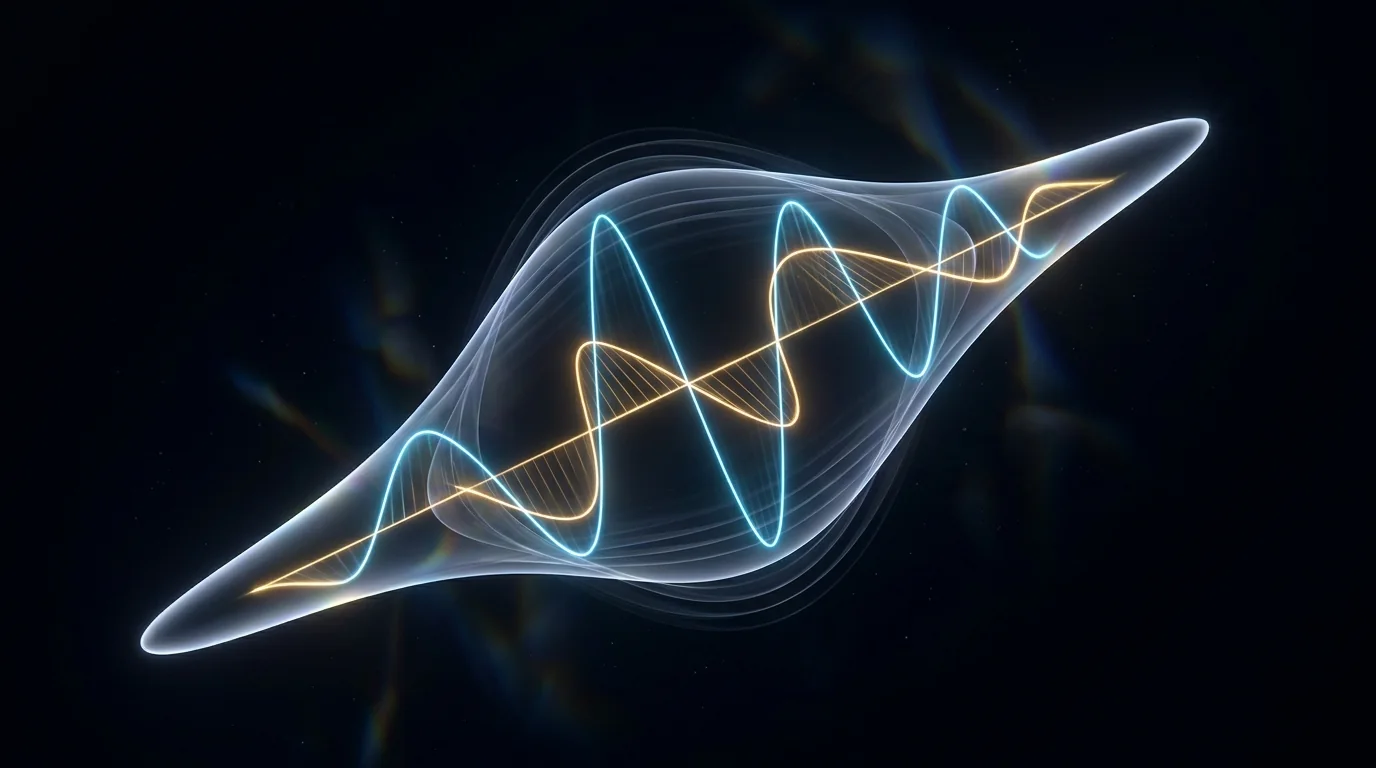
Every second, trillions of photons strike your eye — weightless packets of pure energy carrying starlight, the colors of the world, Wi-Fi signals, and the force holding atoms together. Tune the slider below to sculpt a single quantum of light.
Though you encounter photons every millisecond of your life, they defy almost every everyday intuition. They have zero rest mass yet can push spacecraft sails. They are their own antiparticles. They cannot be slowed in vacuum — they are born already moving at full light speed.
Exact by SI definition — defines the meter itself. ~7.5 orbits around Earth per second.
Lorentz invariant; c = 1/√(ε₀μ₀). Universal causal speed limit in Minkowski spacetime.
Theoretically exactly zero. PDG experimental upper bound is below 10⁻⁵⁴ kg!
Non-zero m_γ yields Proca electrodynamics with Yukawa screening V(r) ∝ e^(-r/λ)/r. Bound from solar wind MHD magnetic fields (PDG).
Boson — unlimited photons can occupy the exact same quantum state (that is how lasers work!).
Massless spin-1 bosons possess only 2 transverse helicity states h = ±1 (±ħ), corresponding to circular polarization. Obeys Bose–Einstein statistics.
Photons carry the electric force yet are electrically neutral — which is why two flashlight beams pass right through each other.
Abelian U(1) gauge group forbids tree-level photon–photon self-coupling. Light-by-light scattering occurs only via virtual fermion loops (ATLAS 2017).
The universal conversion key linking wave frequency to discrete particle energy.
Exact SI constant (since 2019). Sets the scale of quantum action: E = hν = ħω, p = h/λ = ħk, and fine-structure constant α ≈ 1/137.036.
The photon is its own antiparticle and is stable — Big Bang photons have been flying nonstop for 13.8 billion years!
Real vector field A_μ is self-conjugate (J^PC = 1^−−). Stable with observational bound > 10¹⁸ yr (rest-frame equivalent); proper time dτ = 0.
How many individual photons stream every second from an everyday lamp or laser? Explore the sheer numbers!
Radio waves from your favorite station, fireplace warmth, forest green, medical X-rays, and gamma bursts from distant black holes — all are the exact same particle: the photon! They differ solely in energy (wavelength). Human eyes perceive less than 0.0035% of the spectrum.
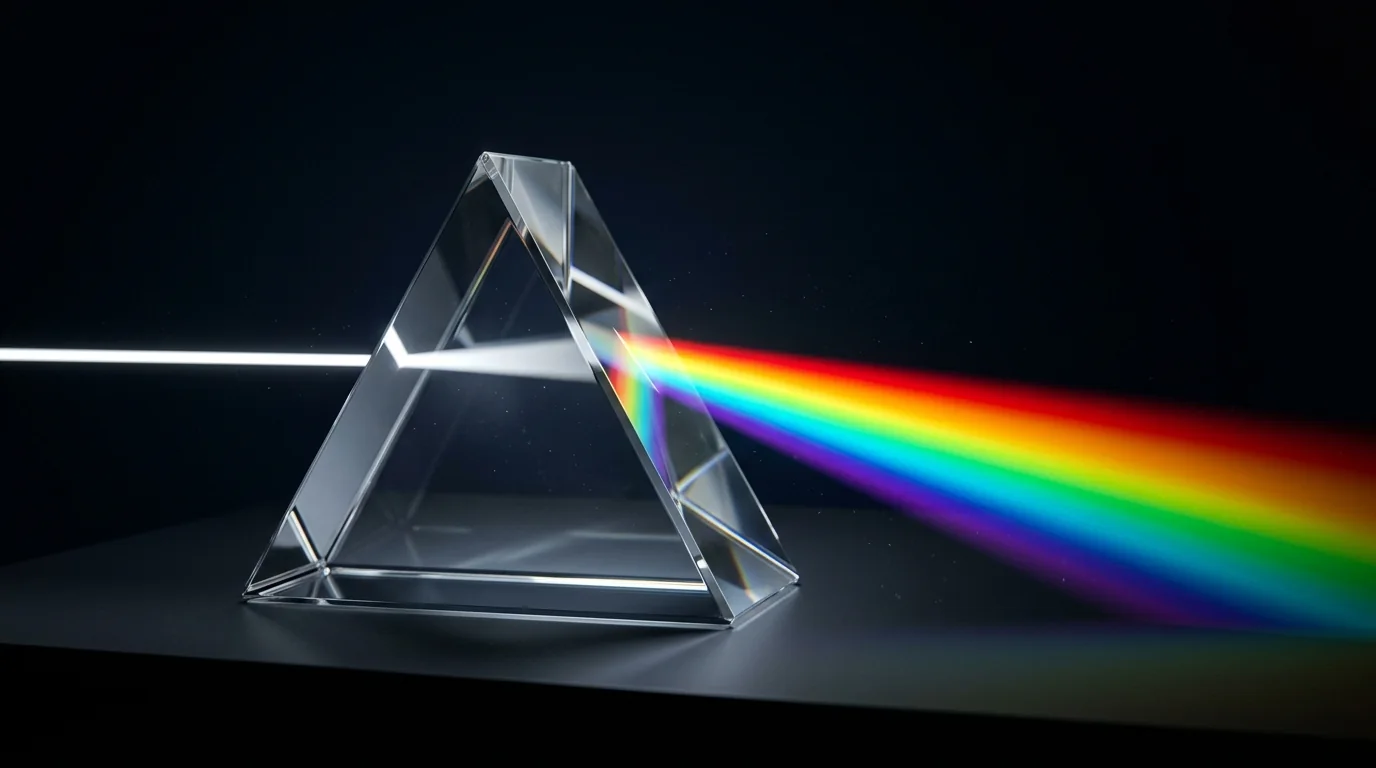
The razor-thin rainbow sliver to which evolution tuned human retinas and plant chlorophyll. A red photon carries ~1.8 eV while violet carries ~3.1 eV — that tiny energy gap paints everything we see.
For 350 years, the debate over whether light is a wave or a particle shattered classical physics and birthed all of quantum mechanics.
Isaac Newton split white light with a prism and argued light consists of tiny flying particles ("corpuscles"). Christiaan Huygens countered with wave fronts spreading like ripples. For a century, Newton’s prestige won out.
Thomas Young shone light through two narrow slits and observed alternating bright and dark interference fringes — the unmistakable signature of waves reinforcing and canceling each other.
Maxwell united electricity and magnetism into four equations. Computing the speed of electromagnetic waves purely from lab electrical constants yielded the exact speed of light! Light was a self-sustaining dance of electric and magnetic fields.
Classical physics predicted that a hot oven should radiate infinite ultraviolet energy (the "ultraviolet catastrophe"). Max Planck solved the crisis by assuming energy can only be emitted in discrete packets — quanta.
26-year-old Albert Einstein went far beyond Planck: light itself travels through space as discrete energy packets! This explained why dim violet light ejects electrons from metal while blindingly bright red light ejects none.
Even after Einstein’s Nobel, many physicists doubted light quanta were real. Arthur Compton settled it forever: X-rays bouncing off electrons recoiled exactly like billiard balls, losing energy and shifting to longer wavelengths!
For 21 years, physicists simply called it a "light quantum." In a 1926 letter to Nature, physical chemist Gilbert N. Lewis proposed a sleek new name from the Greek phōs (φῶς, light): the photon.
Paul Dirac finally reconciled wave and particle! He showed that an electromagnetic field permeates all space, and a photon is a single indivisible ripple — a quantized excitation — of that field.
Feynman, Schwinger, and Tomonaga perfected QED, showing how real and virtual photons mediate all light and electricity. Its predictions match experiment to 12 decimal places — like measuring the width of North America to the thickness of a human hair!
In 1960 the first laser fired, forcing billions of photons to march in perfect lockstep. Roy Glauber then built the quantum theory of optical coherence, distinguishing laser light, thermal light, and single photons.
Einstein called entanglement "spooky action at a distance" and hoped hidden variables explained it. John Bell devised a sharp test, and Alain Aspect’s 1982 entangled-photon experiment proved nature violates classical local realism!
When two perfectly identical photons hit opposite sides of a 50:50 beam splitter simultaneously, quantum interference forces them to ALWAYS exit together down the same path — never separately!
Anton Zeilinger’s team demonstrated photonic quantum teleportation in 1997. Today single photons distribute quantum encryption keys even from orbit! In 2022 Aspect, Clauser, and Zeilinger won the Nobel Prize in Physics.
Classical physics says two light beams can never collide. Yet in 2017 the ATLAS experiment at CERN’s Large Hadron Collider directly observed light scattering off light via quantum vacuum fluctuations!
Do not take it on faith — run the experiments yourself! Four real-time simulations powered by exact quantum equations.
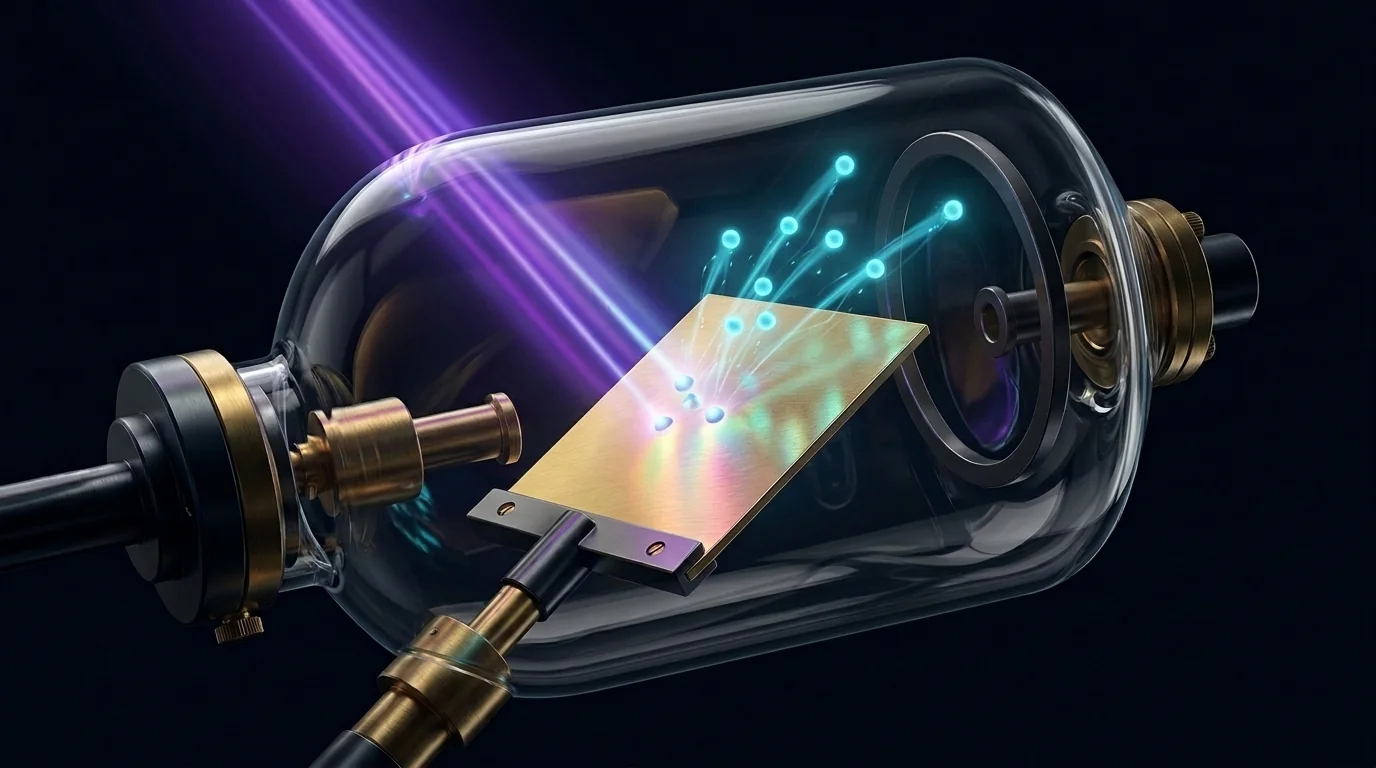
K_max = hν − Φ. Photoemission from metals (Cs, Na, Zn, Cu, Pt) depends strictly on individual photon energy above the work function.
P(y) = |ψ₁ + ψ₂|². Single photons build interference fringes one by one; enabling a which-path detector collapses fringes into classical bands.
Δλ = (h/m_e c)(1 − cosθ), λ_C = 2.426 pm. Relativistic scattering of X/γ photons off electrons proves massless photons carry momentum p = h/λ.
B_λ(T) = (2hc²/λ⁵)/(e^(hc/λk_BT) − 1). Energy quantization eliminated the classical Rayleigh–Jeans ultraviolet catastrophe and birthed quantum physics.
The photon does not merely illuminate — it mediates every electromagnetic interaction, carries quantum entanglement, and powers tomorrow’s physics.
Why do two electrons repel? In QED they exchange a “virtual photon” — a fleeting quantum ripple in the electromagnetic field that transfers momentum from one charge to the other!
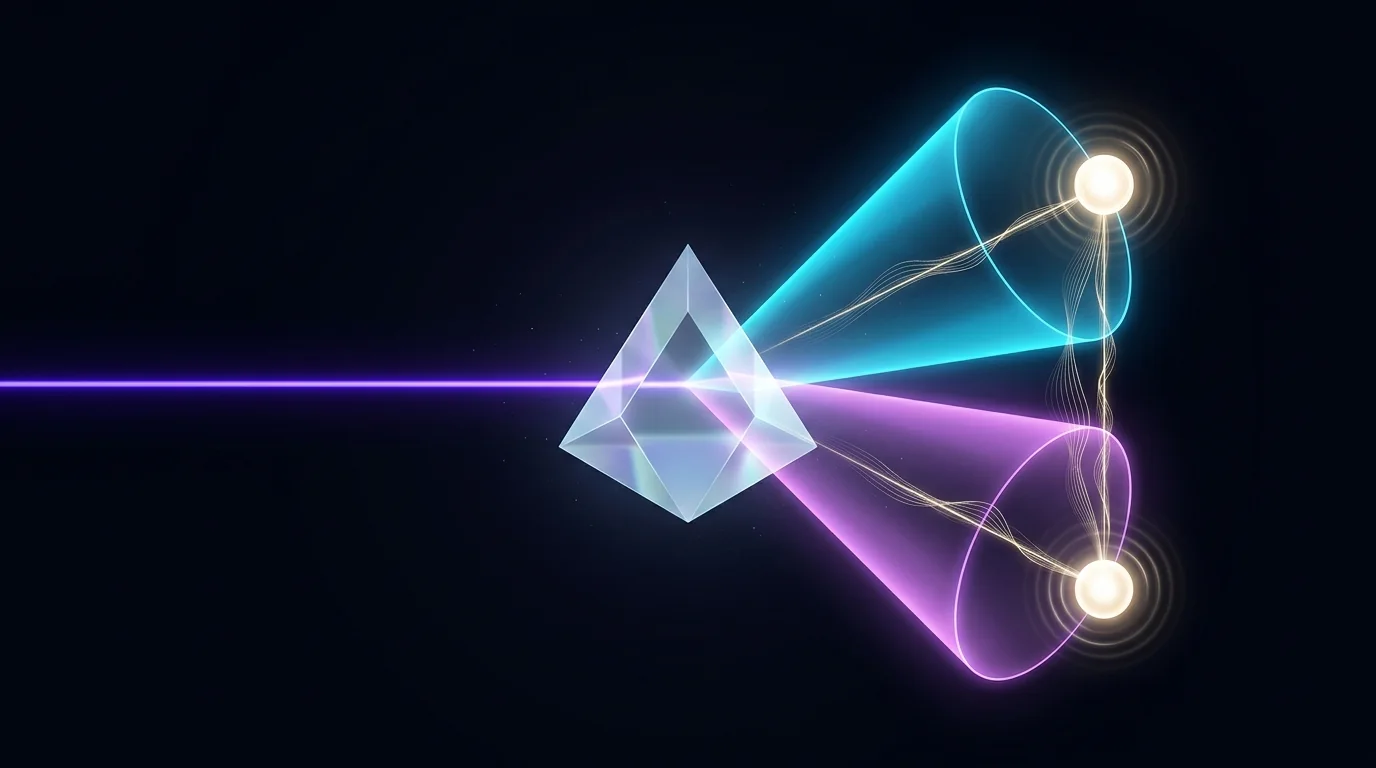
Two entangled photons share instantaneous polarization correlations across any distance. Sweep the polarizer angle θ: around 22.5°, the CHSH score S smashes past the classical limit of 2.0 — proving nature defies local hidden variables!
The shorter a laser pulse (like an attosecond 10⁻¹⁸ s flash), the broader the rainbow of photon energies it MUST contain. Nature forbids simultaneously sharp arrival time and perfectly sharp color.
Light can twist like a corkscrew! Circularly polarized photons carry spin ±ħ and can physically spin microscopic particles — while “twisted” vortex beams encode extra channels of orbital angular momentum.
Electrons are loners (Pauli exclusion makes solid matter sturdy). Photons are sociable bosons: they love crowding into the exact same quantum state! Stimulated emission clones identical photons to forge a laser beam.
How photons carry the 13.8-billion-year story of the cosmos, power all life on Earth, and trigger a neural impulse from a single quantum.
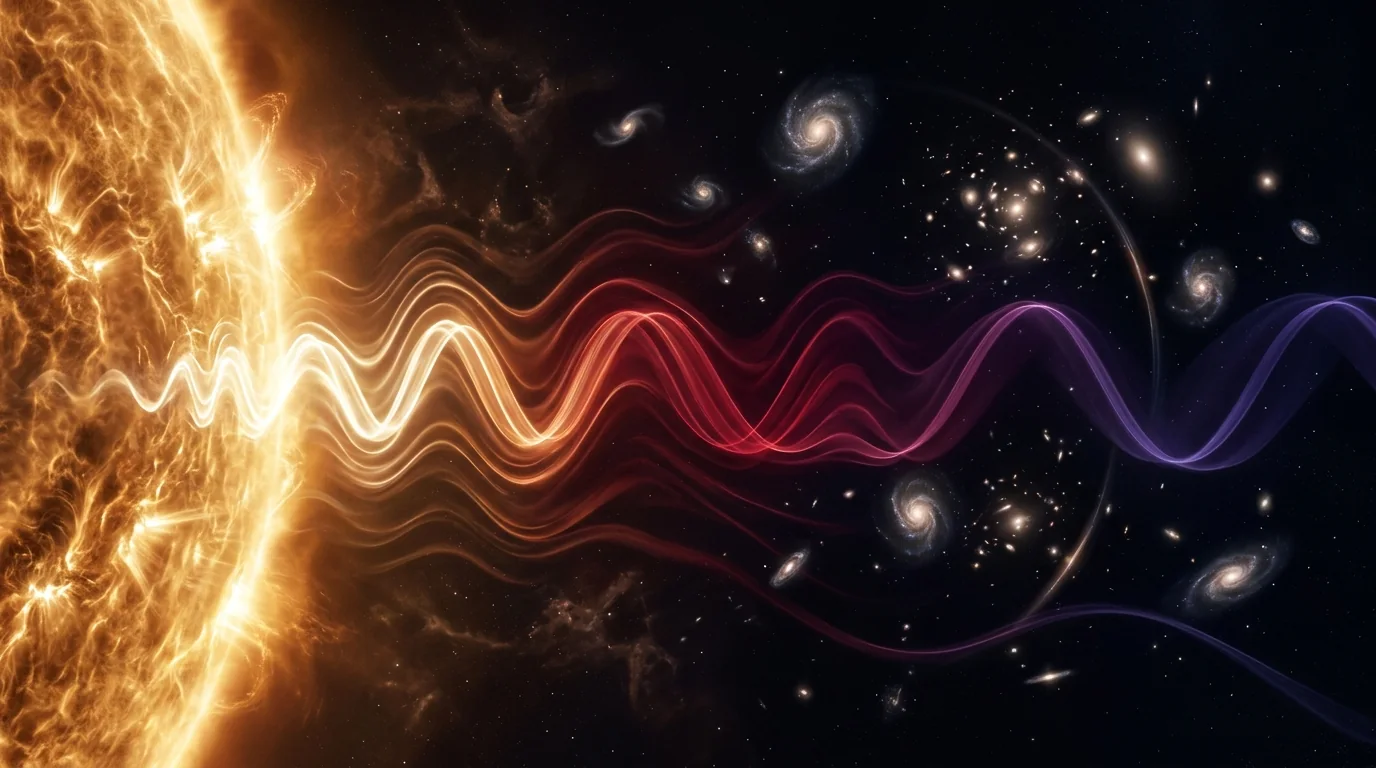
Journey of Cosmic Microwave Background (CMB) photons: from blazing 3000 K primordial plasma (380,000 years post-Big Bang) stretched by expanding space into 2.725 K microwaves.
The oldest light in the Universe! Emitted 380,000 years after the Big Bang as warm golden 3000 K light, expanding space stretched its wavelength 1,100-fold into 2.725 K microwaves. Over 411 CMB photons fill every cubic centimeter around you right now!
In total darkness, a human retinal rod cell can fire from ONE single photon! In 2016, Tinsley et al. (Nature Communications) demonstrated humans can consciously report single-photon flashes above chance.
Almost every calorie you eat and every breath of oxygen is stored solar photon energy. Chlorophyll antenna complexes funnel absorbed photon energy to reaction centers with near-95% quantum efficiency!
If photons have zero mass, how can black holes trap them and galaxies lens them? Because gravity curves spacetime itself — photons simply follow the straightest possible paths across curved cosmic geometry!
Despite zero mass, photons carry real momentum! Bouncing off mirror-thin sails (IKAROS, LightSail 2), sunlight propels spacecraft with zero fuel. In labs, focused lasers trap single living cells and DNA molecules (2018 Nobel)!
Six surprising questions that trip up even seasoned science enthusiasts. Earn your Quantum Observer badge!
Every scientific claim on this page is anchored in landmark peer-reviewed publications. Follow any verified DOI directly to the journal publisher.
The landmark unification of electricity, magnetism, and optics — demonstrating that light is an electromagnetic wave traveling at c.
Complete derivation of the blackbody radiation law introducing energy quantization and Planck’s constant h.
Revolutionary hypothesis of localized light quanta (photons) and explanation of the photoelectric effect (1921 Nobel Prize).
Decisive experimental proof that individual photons carry discrete momentum p = h/λ in collisions with electrons.
The famous letter to Nature that coined and popularized the name “photon” for the quantum of light.
Quantization of the electromagnetic field — founding Quantum Field Theory and explaining spontaneous emission from first principles.
Space-time formulation of Quantum Electrodynamics (QED) introducing Feynman diagrams and virtual photon exchange.
Cornerstone of modern quantum optics: rigorous quantum theory of optical coherence and photon counting statistics (2005 Nobel).
Bell’s theorem transforming the philosophical Einstein–Bohr debate into a decisive experimental test of local realism.
Landmark entangled-photon test violating Bell’s inequalities with overwhelming precision (2022 Nobel Prize).
Discovery of purely quantum two-photon interference (the HOM dip) — foundational for photonic quantum computing.
First experimental demonstration of quantum state teleportation using entangled photons (2022 Nobel Prize).
First loophole-free Bell test closing detection and locality loopholes simultaneously via entangled photons across 1.3 km.
Astonishing quantum-biology experiment showing that dark-adapted human eyes can detect a single individual photon!
Direct LHC observation of elastic light-by-light scattering (γγ → γγ) — a pure quantum vacuum loop effect of QED.